
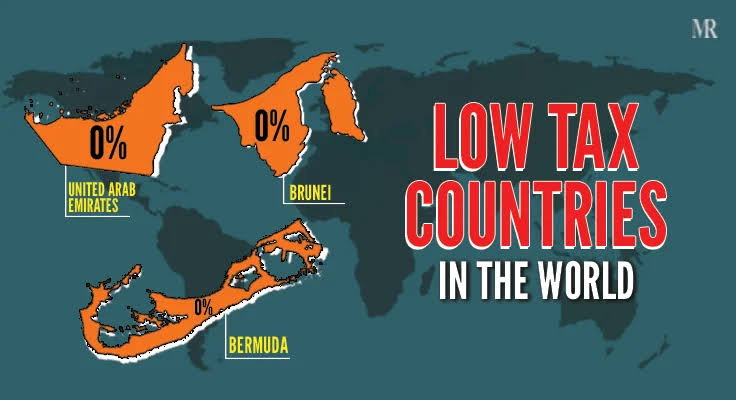
If you're shopping jurisdictions for tax efficiency, the 2026 list of lowest-tax countries has a few familiar names alongside some recent additions. Here's where the rates are lowest right now.
List Of The Top 10 Lowest Tax Countries In The World In 2026
1. United Arab Emirates

The UAE taxes personal income, capital gains, gifts, inheritance, and real estate only. Businesses who turn a profit higher than AED 375,000 pay just 9% corporation tax. Among the lowest company taxes in the world are those here. While the Emirates does not award citizenship by investment, at least AED 750,000, or $205,000 will help one obtain a renewable resident permit. Every foreigner having a residency visa is seen as a tax resident of the UAE. Still, one needs spend 180+ days residing in the country to get a Tax Residency Certificate. You will need this certificate if you pay income taxes in another state and want to apply a double tax treaty to cut your taxes there.
2. Bahamas

The Bahamas is a nation that is highly livable, as it does not impose an income tax. A temporary residency visa can be obtained by paying $1,000 at the immigration office, and it is renewed annually. The Bahamas’ economy is experiencing a rapid recovery, which is being driven by substantial tourism inflows. Tourism, banking, cement, hydrocarbon transshipment, salt, rum, pharmaceuticals, and spiral-welded steel pipes are among its principal industries. The World Bank reports that the Bahamas has a high GDP per capita of $31,458, despite its status as a minor island developing state. Since mid-2022, inflation has been decreasing. The current account deficit is anticipated to decrease from 8.2 percent of GDP in 2022 to 6.2 percent of GDP in 2023 as a result of a substantial tourism rebound.
3. Qatar

Although Qatar is well-known for its opulent way of life and great quality of living, another fascinating information about the nation is that income tax is not applied there. The tax system of the nation is meant to create income by means of taxes on companies and corporations as well as oil and gas exports. The nation does not levy a personal income tax on its people or inhabitants, hence they do not have to pay taxes on their income from employment or investments. For people trying to reduce their tax load, the no-tax plan appeals.
4. Vanuatu
 Remote workers, entrepreneurs, and international businesspeople could all find Vanuatu appealing. New tax residents annually drawn to the eighty-three island nation by the tax-free policy on wages, dividends, pensions, and other profits are Vanuatu’s only real tax on individuals is 12.5% on local property rental income. For businesses, annual profit tax exemption will last 20 years. The license cost annually is $300. Twelve-five percent VAT applies most goods and services brought into Vanuatu by registered taxpayers in taxable business. Nobody has to submit an annual personal tax return using the customs and inland tax receipts of the island. Once you become a tax resident, the department issues a tax clearing certificate. Donors of $130,000 to a local development fund can become citizens of Vanuatu. Along with a terrific place to reside permanently, the passport allows visa-free access to 97 countries and territories.
5. Bahrain
 Bahrain charges no income taxes; only companies involved in the gas and oil sector pay the 46% corporation tax. The VAT percentage nationally is 10%. Stamp duty falls between 1.7 and 2%; municipal taxes on leasing real estate to foreigners run around 10%. While the country cannot provide citizenship by investment, one can obtain residence by real estate purchase, investment of $270,000+, or retiring with sufficient income. Bahrain has hot summers and mild winters. Of the population, nearly half are expats. Being a Muslim country, respect of local customs and religious traditions is expected.
6. Cayman Island

The Cayman Islands, another British Overseas Territory situated in the Caribbean Sea, is distinguished by its tax-free status. The islands do not impose a corporate income tax, capital gains tax, or estate tax. This is primarily due to the fact that the Cayman Islands lack their own government and rely extensively on financial services to sustain their economy. Additionally, they have a robust financial services sector that draws the attention of numerous multinational corporations seeking tax-efficient locations. Nevertheless, the worldwide income of individuals residing on the islands is subject to UK income tax.
7. Monaco

In 1869, Monaco became one of the first administrations to abolish income taxes. The liveability score is inherently high; however, the lifestyle will require a substantial income to be attainable. It is one of the most straightforward countries to become a citizen of, as it is tax-free. In order to initiate a citizenship application, Monaco institutions require a minimum deposit of 500,000 to 1,000,000 euros. It has one of the lowest crime rates in the globe. Consequently, a nation that is among the lowest-taxed in the world is enticing numerous billionaires. Gambling, tobacco, the telephone network, and the postal service are among the industries in which the state maintains monopolies. The Monte Carlo Casino and the rail link to France were inaugurated in the late nineteenth century, which stimulated economic expansion. Currently, the primary sectors of Monaco’s economy are finance, services, and real estate.
8. Bermuda

In addition to the income tax that is already in existence, Bermuda does not have a value-added tax. A corporation tax is determined by the quantity of share capital that the corporation possesses, with the exception of a property tax, which is computed based on the annual rental value of the property. The country lacks the ability to acquire citizenship through investment in the context of citizenship. Conversely, in order to qualify as an inhabitant, an investment of at least $2.5 million is required. Bermuda offers numerous benefits, including a subtropical climate, breathtaking coastlines, a rich history and culture, and amiable residents. Bermuda provides a variety of benefits, including the following.
9. Brunei

Taxes are viewed as governments’ means of public income generation. Being one of the richest nations in the world with a highly steady economy and good quality of living, Brunei boasts zero sales tax. But Brunei’s government’s oil and gas sector has accumulated a great wealth over the years, so it does not depend mostly on taxes. Furthermore, Brunei’s government upholds economic stability and has decided not to impose a sales tax in order to prevent any possible economic unrest. Brunei also boasts a sizable foreign exchange reserve, which helps to offset its economy in times of worldwide recession. Consequently, among the low tax countries, this small nation ranks among the top.
10. Saudi Arabia

With its ambitious economic reforms and diversification initiatives, Saudi Arabia has attracted interest lately Absence of individual income tax is one of the main features of Saudi Arabia’s tax system. Saudi Arabia will remain a nation with 0% income tax for its people in 2026. Though there isn’t a direct income tax, Saudi Arabia does have other kinds of taxes in effect. Most products and services are taxed by the nation a 5% value-added tax (VAT). Not income, but rather based on net worth, Zakat is a religious wealth tax applied to Saudi Arabian people and interests. For Zakat, the effective rate is 2.5% of net value. Regarding the number of days one needs actually live in the nation, there are no particular residency requirements. To be regarded as a resident for tax purposes, nevertheless, a person must spend at least thirty days in Saudi Arabia throughout the tax year and have a permanent place of residence there.




Comments (0)